The cortex is simple to spot in a dissected kidney because it is lighter in color than the remainder of the kidney. 1 the nephron which produces the filtrate and 2 the collecting tubule which serves to concentrate the filtrate by the further removal of water.

Gross Anatomy Of The Kidney Anatomy And Physiology Ii
As urine is produced in these tiny.
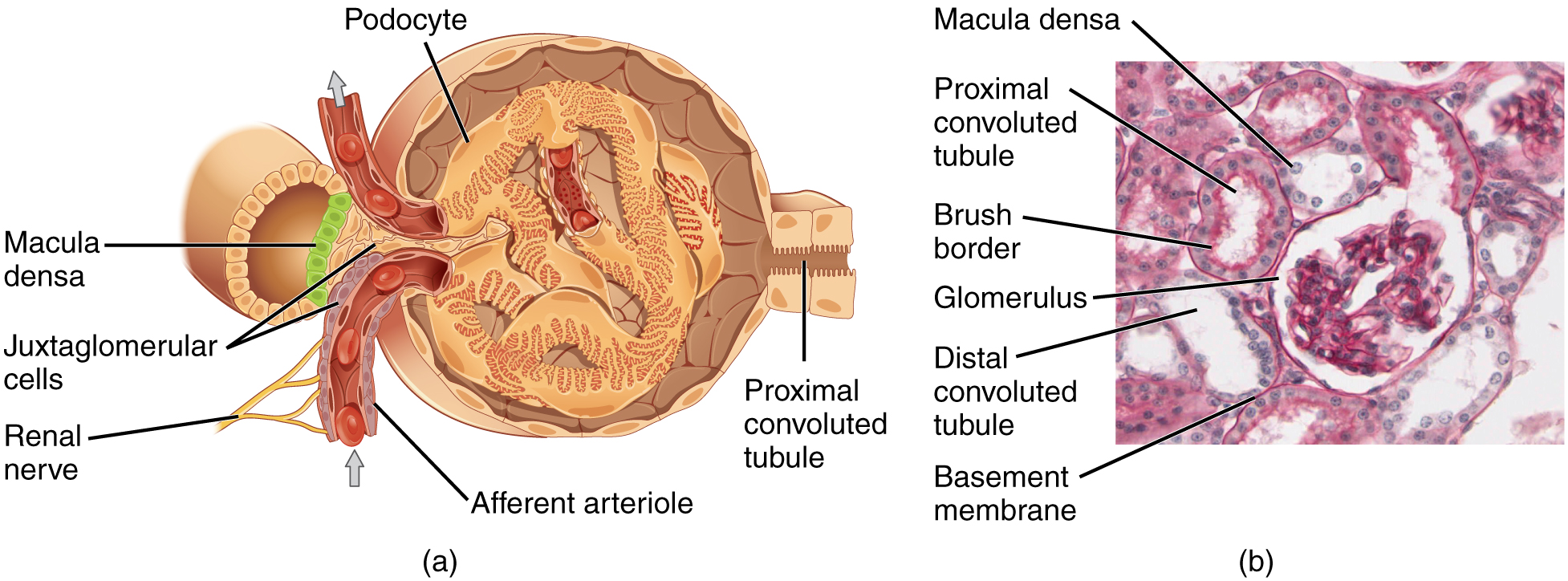
. A network of capillaries in the cortex. Microscopic structures of the kidney. Parallel hairpin structures formed by some branches of the peritubular capillary bed that accompany the nephrons loop of Henle into the medulla.
Its a microscopic structure responsible for urine production. The spherical first part of a nephron that occurs only in the cortex of a kidney. Urinary bladder got emptied from the opening called urethra that is guarded by the sphincter muscles.
The microscopic unit of a kidney that creates urine and composed of a renal corpuscle and renal tubule. Each kidney weighs about 125175 g in males and 115155 g in females. Describe the gross and microscopic structure of the kidney The kidney is divided into an outer cortex and inner medulla.
In the longitudinal section it is seen that the kidney is enclosed in a thin capsule of connective tissue. Cortical nephrons have short loops of Henle whereas juxtamedullary nephrons have long loops of Henle extending into the medulla. About 15 percent of nephrons are juxtamedullary.
In males and 135 gms in females. And this process takes place in three steps. Each kidney is about 10 to 13 cm 4- 5 inches in long 6 cm.
The renal columns serve to divide the kidney into 68 lobes and provide a supportive framework for vessels that enter and exit the cortex. Macroscopic structure of the urinary system Microscopic anatomy of t SlideShare uses cookies to improve functionality and performance and to provide you with relevant advertising. The first step is filtration in which almost all of the small molecules are filtered out of the bloodstream and into the tubule.
As noted previously the structure of the kidney is divided into two principle regionsthe peripheral rim of cortex and the central medulla. The functional unit of the kidney the nephron consists of the renal corpuscle PCT loop of Henle and DCT. As you will see later these are important differences since different portions of the loop have different permeabilities for solutes and water.
The uriniferous tubule is the basic functional unit of the kidney. Describe both the macroscopic and microscopic structure of the Kidney including at least Kidney Position location Sizē renal Vasculature capsule cortex mediula. Urine formed by the kidneys is collected in the renal pelvis and transferred by the ureters into the urinary bladder.
Upper portions of the kidneys are somewhat protected by the eleventh and twelfth ribs Figure. About 15 percent of nephrons are juxtamedullary. Each tubule consists of two distinct morphological entities.
The functional unit of the kidney the nephron consists of the renal corpuscle PCT loop of Henle and DCT. Step 1 of 4. On the upper end of each kidney suprarenal glands are situated like a cap.
Kidneys are dark brown in colour and are embedded in a mass of fat. Describe the Structure and Functioning of Nephrons. The descending and ascending thin portions consists of simple squamous epithelium.
The functional unit of the kidney the nephron consists of the renal corpuscle PCT loop of Henle and DCT. The renal pyramids empty urine into the calyces that drain into the renal pelvis. Nephrons type locations loop of henic DCT PCT Bowmans capsule juxtaglomerular apparatus filtration Membrane.
Cortical nephrons have short loops of Henle whereas juxtamedullary nephrons have long loops of Henle extending into the medulla. The ascending thick portion consists of simple cuboidal epithelium similar to the DCT. A tuft of fenestrated capillaries inside the renal corpuscle.
Cortical nephrons have short loops of Henle whereas juxtamedullary nephrons have long loops of Henle extending into the medulla. Nephrons are the microscopic structural and functional unit of the kidney. Microscopic Structure of the Kidney LS.
From there urine flows into the ureter and is transported to the bladder to be stored. The nephron consists of two compartments. The left kidney is located at about the T12 to L3 vertebrae whereas the right is lower due to slight displacement by the liver.
They are protected in the retroperitoneal space by the renal fat pad and overlying ribs and muscle. The two kidneys receive about 25 percent of cardiac output. About 15 percent of nephrons are juxtamedullary.
2 ½ inches wide and 3 cm. Kidneys are the structural and functional unit of the excretory system. The cortex and medulla contain many nephrons the microscopic filtering units of the kidney responsible for producing urine.
Nephrons are composed of a renal corpuscle and a renal tubule. The average weight of adult kidney is about 150 gms. The nephrons confer both the functional as well as structural unit of the kidneys.
The nephron is the functional unit of the kidney. Collecting ducts Papilla columns calyces pelvis. This capsule maintains the kidneys shape and protects the inner tissues.
If you continue browsing the site you. The pyramids and renal columns taken together constitute the kidney lobes. The proximal convoluted tubules PCTs and distal convoluted tubules DCTs are both located here as are all of the renal corpuscles.
The bean-shaped kidneys have an outer convex side and an inner concave side called the renal hilus where the renal artery vein and ureter are found. The kidney is differentiated into two regions the outer cortex and inner medulla. 1 ½ inch in thickness.
The nephron is the microscopic structure of the kidney made up of about one million small tubes known as the tubulues. The malphagian body and the renal tubes. A short Henle loop exists in some nephrons that does not extend beyond the cortex.
A thin connective tissue called the renal capsule surrounds each kidney. The renal corpuscle consists of a tuft of capillaries called a glomerulus and an encompassing Bowmans capsule. The nephron is composed of the glomerulus the juxtaglomerular complex the proximal convoluted tubule the.
The medulla is composed of renal pyramids seperated by renal columns.

Microscopic Anatomy Of The Kidney Anatomy And Physiology Ii

Macroscopic Anatomy Of The Kidney Principles Of Human Physiology Download Scientific Diagram
22 3 Microscopic Anatomy Of The Kidney Medicine Libretexts



0 Comments